Borobudur Temple Tour from Yogyakarta: A Complete Traveler’s Guide

I’ve always believed that some places carry a kind of energy you can’t really put into words. For me, Borobudur Temple was one of those places. The first time I took a Borobudur tour from Yogyakarta, I went in with high expectations—I mean, it’s the world’s largest Buddhist temple, right? But honestly, it still managed to blow me away. Not just because of its size or beauty, but because of the entire journey: the early wake-up call, the ride through sleepy villages, the smell of coffee plantations along the way, and finally, watching the sunrise over the misty Kedu Valley with Borobudur standing tall in the foreground.
So if you’re planning a trip to Yogyakarta, a Borobudur Temple tour should definitely be on your list. Let me walk you through my experience, plus all the tips I wish I’d known before going.
Why Start from Yogyakarta?
Most travelers base themselves in Yogyakarta when visiting Borobudur, and for good reason. The city is lively, full of culture, and only about 40 kilometers from the temple (roughly an hour to 90 minutes by car depending on traffic).
When I first landed in Yogyakarta, I thought of it as just a jumping-off point, but the city itself deserves attention. It’s home to Prambanan Temple, Malioboro Street, traditional batik workshops, and some of the best Javanese food I’ve ever had. But for me, Borobudur was the crown jewel.
The Early Morning Struggle: Sunrise at Borobudur
I’ll be honest—I’m not a morning person. When my alarm went off at 3:30 a.m., I thought about skipping it altogether. But trust me, the sunrise at Borobudur is worth every ounce of lost sleep.
I joined a small group tour that left from my hotel in Yogyakarta around 4 a.m. The van ride was quiet—most of us were still half-asleep, clutching water bottles and trying not to nod off. When we finally arrived at the Manohara Hotel entrance (the only official way to access Borobudur for sunrise tours), the air was cool, and there was a hush over everything.
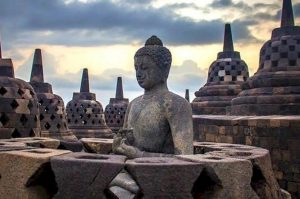
Climbing up the temple in near darkness felt almost sacred. By the time we reached the top, the horizon was already softening into pinks and oranges. Then, as the sun rose, the mist around the surrounding mountains—Merapi and Merbabu—started to lift, revealing the temple’s 72 stupas and endless stone carvings. That moment was magic. I’ve seen plenty of sunrises, but this one genuinely gave me goosebumps.
How Much Does a Borobudur Tour Cost?
Okay, let’s talk numbers, because this part confused me at first.
- Regular Day Entrance: About IDR 375,000 for foreign adults (~$25).
- Sunrise Entrance via Manohara: Around IDR 500,000 (~$33). This includes a small snack and coffee.
- Private Driver from Yogyakarta: Usually IDR 500,000–700,000 (~$35–50) for a car and driver for the day.
- Group Tours: Can be cheaper, around IDR 150,000–250,000 per person, but you’ll be stuck to their schedule.
The sunrise ticket might seem pricey, but it was hands-down the highlight of my trip, and I don’t regret a single rupiah spent.
Getting There: Transport Options
I tried two different ways of getting to Borobudur on separate trips, and both had their pros and cons.
- Private Driver – This is the most flexible option. I loved being able to stop at a coffee plantation on the way back and take photos in random rice fields. If you’re traveling with friends, it’s also cost-effective since you split the price.
- Group Tour – I did this the second time mostly to save money. It was efficient, but less personal. Also, we had to stick to the guide’s timeline, which felt a bit rushed.
- Public Transport – Yes, it’s possible. You can take a TransJogja bus to Jombor terminal and then another bus to Borobudur. But honestly, after hearing how long it takes (up to 3 hours), I decided against it. Time is valuable when you’re traveling.
Exploring the Temple
Here’s a tip I wish I knew before: don’t rush straight to the top. I did that my first time and later realized I missed out on so many details carved into the lower levels.
Borobudur is built like a massive mandala, with three main levels representing Buddhist cosmology:
- Kamadhatu (the world of desire) – the base level, with carvings showing human desires and consequences.
- Rupadhatu (the world of forms) – middle levels, featuring hundreds of relief panels and Buddha statues.
- Arupadhatu (the world of formlessness) – the top circular terraces with stupas and the iconic central dome.
One thing that struck me was how every stone relief told a story. There are over 2,600 panels and 500 Buddha statues. My guide pointed out carvings of ships, daily village life, and even ancient medical practices. It really brought the temple alive.
Combining Borobudur with Other Attractions
If you’re making the trip from Yogyakarta, you might as well make a full day out of it. I usually combined Borobudur with a stop at:
- Mendut Temple – A smaller Buddhist temple just 3 km away. It has a giant statue of Buddha that’s incredibly detailed.
- Pawon Temple – Even smaller, but perfectly aligned between Mendut and Borobudur. Locals believe the three temples were connected in rituals.
- Local Villages – I once rented a bicycle and cycled through the surrounding villages, passing rice paddies, pottery workshops, and little warungs (street food stalls). Best decision ever.
What to Wear and Bring
I made the rookie mistake of wearing sandals the first time. Don’t do that—there are steep stairs, and my feet were screaming by the end. Here’s my go-to list now:
- Comfortable walking shoes.
- A light jacket (it’s chilly before sunrise).
- A hat and sunscreen for later in the day.
- Reusable water bottle.
- Modest clothing (you’ll be given a sarong at the entrance, but better to dress respectfully).
Best Time to Visit
I went once in August and once in January. Big difference.
- Dry Season (April–October): Best chance for clear skies, but it’s also busier.
- Rainy Season (November–March): Fewer crowds, but risk of cloudy sunrise. My January trip had mist, but honestly, it added to the atmosphere.
If I had to pick, I’d go for the shoulder months like May or September—good weather, fewer tourists.
Eating Near Borobudur
One of my favorite parts of travel is food, and Borobudur didn’t disappoint. Right outside the temple complex, there are plenty of small warungs serving nasi goreng, soto, and tempeh. On my second trip, I stopped at a local restaurant overlooking rice fields and had a bowl of gudeg (a Yogyakarta specialty made from jackfruit). Sweet, savory, and perfect after a long morning of climbing stairs.
Final Thoughts: Was It Worth It?
Absolutely. Visiting Borobudur from Yogyakarta wasn’t just about checking off a UNESCO World Heritage site from my list. It was about feeling that connection to history, watching the sun rise over ancient stones, and realizing that people built this massive monument over 1,200 years ago without modern tools.
Sure, the 3 a.m. wake-up call was brutal, and yes, the ticket price stung a bit, but I’d do it again in a heartbeat. If you’re traveling to Yogyakarta, don’t just think about Borobudur as a half-day trip—make it an experience. Take your time, hire a guide if you can, and let yourself get lost in the details.
SEO-Optimized FAQ: Borobudur Tour from Yogyakarta
- How far is Borobudur from Yogyakarta?
It’s about 40 km away. By car, it takes 60–90 minutes depending on traffic. - Is the sunrise tour at Borobudur worth it?
Yes, the sunrise experience is the most magical way to see the temple, with misty valleys and mountains in the background. - Can you visit Borobudur without a tour?
Yes, you can hire a driver or even take public buses. Tours just make the process easier. - How long do you need at Borobudur?
At least 2–3 hours inside the complex to fully explore the carvings and levels. - Is Borobudur open every day?
Yes, it’s open daily from 6 a.m. to 5 p.m. Sunrise tours start earlier via the Manohara entrance. - What should I wear to Borobudur?
Modest clothing (shoulders covered), comfortable shoes, and a hat or sunscreen for later in the day. - Can you climb to the top of Borobudur?
Yes, visitors are allowed to climb the temple levels and walk around the stupas, but access may sometimes be restricted for conservation.